Between the tick and the tock
Helen began the MA course to gain a theoretical context for her work. In this presentation she showed how strands of reading and thinking had woven amongst her art-making, enriching her journey, informing her work at an unconscious level.
Eva Hesse had shown her early on how thinking and making could be integrated, focused around the crucial question 'who am I?' Jacques Lacan's structuring of the psyche had been influential, as had Julia Kristeva's writing about 'the abject' - that which 'disturbs identities, systems and orders' - and her idea that the arts are a way to purify the abject.
A major project during the course has been the building about to be redeveloped at the Royal Sussex County Hospital, a site that holds emotional and symbolic significance for her. She has taken hundreds of memories of the empty building which have fed into two large paintings in which she used layering to evoke a sense of the liminal.
A number of women artists informed this work - Louise Bourgeois, Cornelia Parker, Mona Hartoum and Doris Salcedo - making sculptures in unusual material. Works with a semi- transparent element - Roni Horn's glass sculptures and Rachel Whiteread's resin work - spoke to her at this point and she produced resin casts of hospital bricks, aware of the history they might be holding.
For her interim show she hung her work from scaffolding, echoing an idea that memories hang from words.
Over last summer she spent a week in a convent where she experienced a lot of anxiety, later recognising that this was part of an essential liminal stage of her journey. This led to some powerful painting on hospital gowns, for which she looked at other artists who use clothes.
For her past session at the hospital she took in some of her own work and photographed on site, at the source of its inspiration.
Helen seems to flow easily between thinking and making, turning as needed to artists and thinkers who will take her further. Her work is characterised by a willingness to experiment with materials, and she encouraged us to make use of the support for this at the university.
http://www.helenacklam.com/
Tuesday, 25 February 2014

Wednesday, 19 February 2014
Rose Waterson
Dynamics and memory within the portrait
BA in Drawing and Fine ArtAims for simplicity in form and ambiguity in meaning.
The main subject of her drawings is members of her family, the theme family dynamics. She has been challenged by how to convey visually changes in family dynamics, loss.
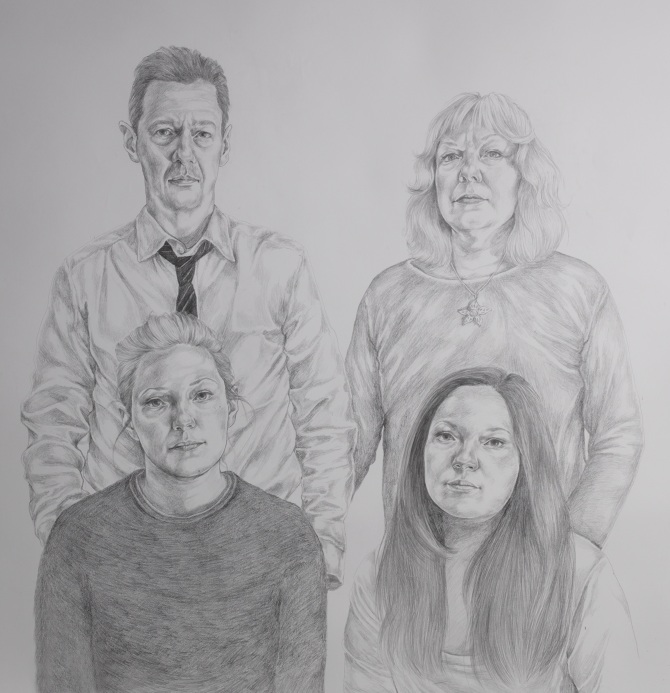
She also does self-portraits which have come to be about self-acceptance.
The portrait genre is a well-filled one and she has had to work hard to find her place in it.
Her style is realistic, sober.
Cites as influences Arshile Gorky, Bonnard and Zhang Huan (who works with ash collected from Buddhist temples).
Recently she has been superimposing images that inform one another e.g. family portraits on to drawings of Birling Gap (which she has known since childhood); projecting images of the sea on to portraits; and now combining video and drawing. She has struggled to master the necessary technology, but doing so has given her work a noticeable authority as well as a much stronger emotional resonance.

Other changes include moving into painting and working much larger. There was a tangible sense of her practice growing more confident.
She said she often judges her work 'awful' but knows it is something she has had to get rid of in herself; she moves out of any loss of confidence at these points by drawing on her collection of secondary images.
www.rosewaterson.com
Alex Birkmyre
Alex aka Lindsey presented the first of a series of talks by final year MA sudents.
There is no one theme in her work; she creates works for herself that unnerve or amuse her and hopes they will affect viewers. She wants to make art that entertains.
She works with a vision of the end result but is sensitive to what is happening during the process of making and will adjust as necessary.
She presented works that ranged across text, sculpture and sound.
Wednesday, 12 February 2014
Ian Munroe
Diamond encrusted skulls and other myths:
art and the creation of markets
art and the creation of markets
 |
| Cumulus 2003, vinyl collage
After offering an introduction to his work and his explanation as to how the commercial art market works, Ian gave a lot of practical advice:
How do you get started?
Make something mad and do it well!
Make sure it's seen by someone who will support me.
Art confounds reason, resists efficiency, reflects/critiques society, is slower than the dominant technologies.
A successful practice is:
Apply for things
Go to shows, events
Document work as I go along - well
Take up any opportunity
I have to 'promote' my work i.e. ask people's opinion, be interested in them
Research any gallery lots before I approach it
How to survive?
Possibilities:
Resources
celeste prize.com
nyfa.org
chicagoartistsresource.org
artquest/ a-n
Choosing a gallery
Does my work fit in?
Who else do they work with?
Get familiar with the work of the gallery artists
Do they get their artists into museums and curated shows?
Are they going to be able to support (i.e. understand) an emerging artist?
What a gallery should do
At least split the cost of framing and photography
Pay for shipping, advertising, invite cards, storage, a proper party for any show
They may split the cost of materials, advance money for specific works, pay to publish a catalogue, pay travel costs to attend events
They won't promote my work as well as I can; critique my work; keep good press and inventory records (I must do this myself - size, date, materials, sale price, where it has gone)
Not a lot of money to be made: once all fees, discounts, tax and costs are taken into account, likely to be under 10% of the sale price.
|
Thursday, 6 February 2014
Mikhail Karikis
Children of Unquiet

A sound and performance artist working in a political context.
MK showed us his film, Children of Unquiet, part of a multi-facetted and multi-layered response to the plight of residents of Devil's Valley in Tuscany who are being edged out of their villages by the primary employer, the geo-thermal plant which no longer needs their labour. MK questions the gloomy prognosis for the area promoted by the plant management and which has been imbibed by the people.
His project has been commissioned by the Sydney Biennale and will tour locations around the world.
The film mixes shots of the turbulent landscape with abandoned homes and industrial plant, children running wild throughout. It sets these to a visceral soundtrack performed by the children who make sound responses to the noises of the earth and the factory.
What makes the film so powerful?
- It's the story of a community at a crucial point in its existence, at risk of vanishing - but with the possibility of a positive outcome.
- MK has worked closely and at length with the community, absorbing their story and re-envisaging it in sound and visual form; continuing to work with them while they lay the foundations for a different future.
- In particular he has worked with the children, taking them around the abandoned villages, using drawing workshops, getting them fully engaged. He said that the most important aspect of the project was that they began to imagine a different future for themselves in the valley (before they had all except one planned to leave it).
- The rhythmic power of the sounds, the fact that they arise out of the landscape and factory - and the high standard of the performances.
- The thought framework which is not evident in the film itself but on which it rests: the political forms of love - that love of other, however different, is the antidote to economic values.
The scenario is a gift of landscape and story, but it has taken MK's vision and energy to make something of it - for the art but primarily for the community itself.
Subscribe to:
Posts (Atom)